The Complete Guide to Agentic Marketing (2026)
Agentic marketing is the discipline of letting AI agents own the marketing loop: read your data, ship A/B tests, manage ads, attribute revenue. This is the playbook for how to do it in 2026.
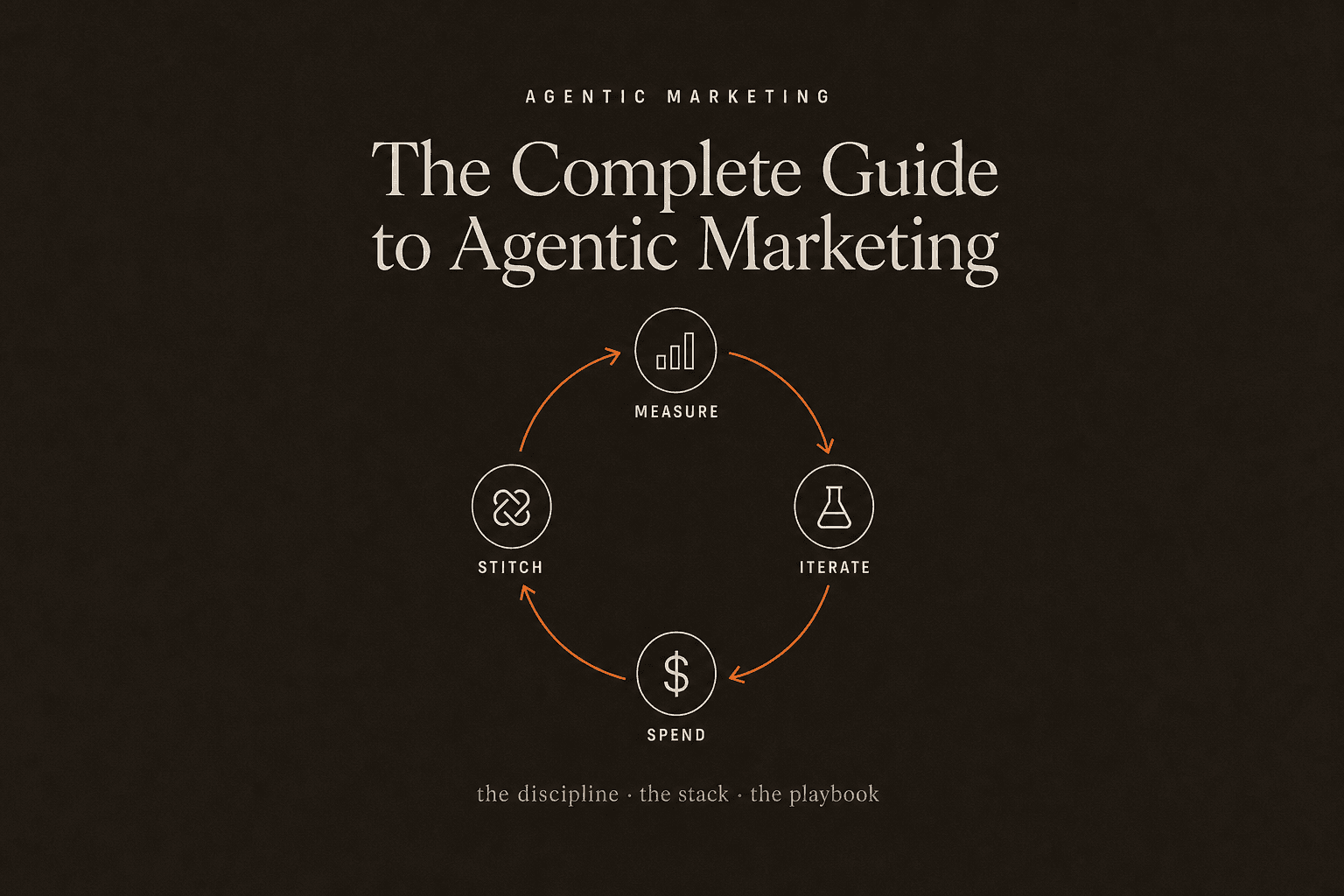
The short answer: Agentic marketing is the practice of letting an AI agent (Claude or Codex) own the marketing loop, read the funnel, ship A/B tests, manage ad spend, attribute revenue, instead of a human clicking through dashboards. The 2026 unlock is a readable data layer the agent can act on. See how to wire it up on the skills page.
Agentic marketing is a discipline, not a tool. And as of May 2026, the action stack to run it actually exists.
Marketing teams are splitting into two camps. One runs campaigns through dashboards (Google Ads UI, Meta Ads Manager, GA4, a Notion doc full of test ideas, a Monday standup where someone asks "did we ship the headline test from two weeks ago?"). The other runs campaigns through agents. Claude or Codex reads the funnel, ships the test, pauses the underperforming creative, reallocates budget, and posts the recap to Slack before standup starts.
The dashboard team works in 9-to-5 cycles. The agent team's CRO loop never sleeps. The gap between them (tests shipped per week, hours of operator toil, ROAS movement landing inside the same week the signal appeared) is widening every quarter.
This guide is for the team that has decided to be the second one. It defines what agentic marketing actually is, separates it from the two adjacent things people confuse it with, walks through the four canonical workflows, and lays out the exact stack you can install this afternoon.
What "agentic marketing" actually means
The term is doing a lot of work in 2026, and most of the work is sloppy. Three categories get conflated. They are not the same thing.
| Discipline | What the system does | Who owns the loop | Canonical tools |
|---|---|---|---|
| Marketing automation | Fires actions on triggers you defined | Human designs every rule, tweaks weekly | HubSpot drips, Zapier, Customer.io |
| AI marketing | Predicts and suggests; humans approve | Human approves every output | Jasper, predictive lead scoring, content suggestion tools |
| Agentic marketing | Plans, acts, observes, iterates against a goal | Human sets goal + guardrails; agent owns the loop | Claude Code + Humblytics + Meta CLI + Stripe Issuing |
Marketing automation is if-this-then-that. The system is a state machine that waits for triggers and does what it was told. The intelligence lives in the human who designed the rules. When the rules go stale, the human comes back and rewrites them.
AI marketing is suggestion plus prediction. A model drafts an email subject line. A predictive score ranks leads. The output is useful, but the loop never closes. A human still has to read, decide, and execute. The intelligence is real but disconnected from the action layer.
Agentic marketing is goal-driven autonomy. The operator gives the agent a goal ("find my worst-performing high-traffic page and ship a fix") and guardrails (scoped tokens, PAUSED defaults, spend ceilings). The agent plans, calls the right APIs, observes, and iterates. The intelligence lives in the loop itself.
Andrew Chen describes this as agents owning the full loop, not just one step of it. Elena Verna's framing is sharper: agents act like junior marketers. Plan, do, learn, repeat. Greg Isenberg talks about the AI team running DTC operations 24/7. Same shift, different angles. It is not 2027 anymore.
Why agentic marketing is happening NOW
Three structural changes in the last twelve months made this possible. None of them existed in operator-grade form a year ago.
LLM agents in CLIs and IDEs. Claude and OpenAI Codex are no longer chatbots that suggest snippets. They read files, run commands, hold context across long sessions, and execute multi-step plans. The shift from "the model suggests" to "the model does" is what opens the loop.
Platform-native APIs and CLIs designed for agents. Meta shipped the meta ads CLI on April 29, 2026: a single binary wrapping the Marketing API, with PAUSED defaults, structured output, and env-var tokens designed for agents. At Stripe Sessions 2026, Stripe shipped Issuing for Agents and Link wallet for agents: scoped virtual cards with two-second authorization webhooks and merchant category limits. Safety baked into the design, not bolted on.
Marketer-readable agent skills. Open-source skill libraries (discrete capabilities loaded as agent context with one line of YAML or markdown) turn marketing playbooks into composable agent functions. Humblytics ships twelve open-source skills (CRO Optimizer, Page CRO, A/B Test Generator, Funnel Reporter, Revenue Attributor, Content Strategist, SEO Strategist, more). The agent does not need to be told how to diagnose a funnel. The skill tells it how. The operator gives the goal.
Three forcing functions, all reaching operator quality in the same six months. That is why now.
The agentic marketing stack
A canonical stack has five layers. Most teams already have layer one and confuse it for the whole stack. Layers two through five are where the lift comes from.
1. Agent core. The LLM-backed CLI or IDE that holds context and executes commands. Claude, OpenAI Codex, or equivalent. This is the brain. Most teams pick one and standardize.
2. Skills layer. Open-source markdown files loaded as agent context, each defining a discrete marketing capability. Humblytics' twelve cover the CRO loop end-to-end: Funnel Reporter reads your analytics, CRO Optimizer diagnoses leaks, A/B Test Generator drafts test briefs, Revenue Attributor joins ad spend to MRR. Skills are the playbook the agent loads before it thinks.
3. APIs, CLIs, and MCP servers. The execution layer. the Humblytics MCP server and API for analytics, A/B tests, and revenue attribution. Meta meta ads CLI for paid ads writes. Meta's hosted MCP at mcp.facebook.com/ads for paid ads reads. Stripe API for payments and Issuing. GitHub CLI for repo writes. CMS API for content writes. Each surface is the agent's hands for one part of the job.
4. Data and observability. First-party analytics the agent can read without consent banners blocking the flow. Cookie-free is not a privacy preference here. It is a structural requirement. If thirty percent of EU traffic drops out of GA4 at the consent banner, your agent is tuning on a thirty-percent-blind dataset and you will not know which decisions were corrupted by that. Humblytics' analytics script uses no cookies or local-storage identifiers, and its analytics layer does not itself require a cookie-consent banner, though a site may still need consent for other tools or uses. Other first-party stacks work too, as long as the data is complete and the agent has API access.
5. Guardrails. Where safety lives. .env for secrets, never in CLAUDE.md, never pasted in chat. Scoped tokens: one ad account per Meta token, one property per Humblytics key, one merchant-category-restricted virtual card per Stripe Issuing scope. PAUSED defaults so nothing publishes spend until a human flips the switch. Two-second authorization webhooks (Stripe Issuing's canonical example) so the agent's spend authority operates inside an envelope you defined explicitly.
A team running on all five layers has a closed loop. A team running on one or two has automation theater.
The four canonical agentic marketing workflows
The workflows below are the ones in production right now at teams using this stack. Each one has the same shape: the operator gives the goal, the agent composes skills and APIs, the human stays in the loop at well-defined boundaries, and the loop runs faster than a human team running the same job manually.
Workflow 1: The CRO Loop
Goal: "Find my worst-performing high-traffic page and ship a fix."
Loop: The Funnel Reporter skill reads /properties/{id}/traffic/breakdown and identifies a page with high traffic but below-median conversion. The CRO Optimizer skill calls /properties/{id}/split-test-recommendations?page=/pricing to get test ideas grounded in the actual funnel data. The Page CRO skill audits the live page for the usual leaks: value prop clarity, CTA contrast, social proof position, form friction. The A/B Test Generator skill calls POST /properties/{id}/split-tests to ship a no-code variant with auto_stop_days: 14.
# 1. Pull the funnel
curl -H "Authorization: Bearer $HUMBLYTICS_API_KEY" \
  "https://app.humblytics.com/api/external/v1/properties/$PROP/traffic/breakdown?start=2026-04-01&end=2026-05-01"

# 2. Get test recommendations grounded in real data
curl -H "Authorization: Bearer $HUMBLYTICS_API_KEY" \
  "https://app.humblytics.com/api/external/v1/properties/$PROP/split-test-recommendations?page=/pricing"

# 3. Ship the variant
curl -X POST -H "Authorization: Bearer $HUMBLYTICS_API_KEY" \
  "https://app.humblytics.com/api/external/v1/properties/$PROP/split-tests" \
  -H "Content-Type: application/json" \
  -d @variant.json
Human in the loop: The operator approves the test brief before it ships (default), or pre-approves a class of tests (headline-only, copy-only, CTA-only) and lets the agent ship inside that envelope. The operator reviews the winner before promoting to 100%. Statistical confidence is enforced by the API; the human enforces taste.
Workflow 2: The Ad Ops Loop
Goal: "Last week's funnel for /pricing dropped six points. Pause every Meta creative below 1% CTR pointing at that page."
Loop: The Funnel Reporter detects the conversion drop. The Revenue Attributor reads /ads/attribution to find which Meta campaigns and ad sets are driving traffic to /pricing. The agent shells out to meta ads insights get for creative-level CTR. For every ad below the threshold, the agent runs meta ads ad update --status PAUSED --no-input. The recap lands in Slack before the standup.
# Pull last 7 days of creative performance, JSON for piping
meta ads insights get --campaign_id $CID \
  --date-preset last_7d \
  --fields ad_id,ad_name,ctr,impressions \
  --output json | jq '.[] | select(.ctr < 0.01)'

# Pause each laggard, no interactive prompt
meta ads ad update $AD_ID --status PAUSED --no-input
Human in the loop: The operator reviews paused creatives in Ads Manager (or in a Slack digest) before market open. Budget reallocates automatically inside the campaign because Meta's algorithm redistributes when bids are paused. No extra agent step needed. The full walkthrough is in the Meta CLI piece: Meta Just Shipped an Ads CLI for AI Agents.
Workflow 3: The Content + Distribution Loop
Goal: "Write our weekly product changelog post, publish it, and queue distribution to LinkedIn and X."
Loop: The Content Strategist skill reads the last seven days of commits and the changelog file. It groups changes by user-visible impact (new feature, improvement, fix) and drops the engineering-internal ones. The Copywriting skill drafts the post in house voice. The SEO Strategist skill optimizes the title, adds internal links, and tightens the meta description. The agent commits the markdown to the repo, opens a PR, and queues social posts to whatever scheduler you self-host or to a service like Buffer via API.
This is the most BYO-tool workflow on the list. There is no canonical agent-CLI for LinkedIn or X yet. Both platforms have APIs but neither has shipped an meta ads-style operator-friendly CLI. Pair this loop with Buffer's API, a self-hosted scheduler, or a third-party MCP for social. Honest framing: the writing, the SEO, and the publishing are agent-native today. The distribution leg is glue code until LinkedIn and X follow Meta's lead.
Human in the loop: The operator reviews the PR. House-voice drift catches in code review faster than it does in a CMS. The agent ships the social posts on the operator's approval, not before.
Workflow 4: The Attribution + Spend Loop
Goal: "If a Meta campaign hits 4× ROAS, scale it. If it drops below 1.5×, pause it."
Loop: The Revenue Attributor pulls /ads/attribution, which joins Meta clicks to Stripe revenue inside Humblytics. The agent reads ROAS as a single number, not a four-step manual join. The agent computes ROAS per campaign over the last seven days. Above 4×, the agent calls meta ads adset update --daily-budget to increase budget by a pre-approved percentage. Below 1.5×, the agent pauses the underperforming creatives. With Stripe Issuing for Agents, the agent can also issue a scoped virtual card to pay for ad-platform charges, paid SaaS subscriptions inside the loop (a competitor-tracking service, an asset library), or supplier payments. All bounded by merchant category code, monthly ceiling, and velocity limit.
# Pull joined ad spend → Stripe revenue
curl -H "Authorization: Bearer $HUMBLYTICS_API_KEY" \
  "https://app.humblytics.com/api/external/v1/properties/$PROP/ads/attribution?period=last_7d"

# Scale a winner
meta ads adset update $ADSET_ID --daily-budget 15000 --no-input

# Pause a laggard
meta ads ad update $AD_ID --status PAUSED --no-input
Human in the loop: The operator sets the ROAS thresholds, the budget step size (don't let the agent triple a daily budget; cap the increase at 25% per move), the merchant categories, and the monthly Stripe Issuing ceiling. The two-second authorization webhook on Stripe Issuing logs every transaction with reasoning, so the audit trail is complete. The agent operates inside the envelope. The operator reviews the envelope weekly and tightens or loosens it based on what the agent shipped.
How to start: the 60-minute setup
Practical, not theoretical. If you have an hour today, you can have an agentic marketing stack live by the end of it.
-
Sign up Humblytics and get an API key (5 minutes). Either grab the key from
https://app.humblytics.com/authdirectly, or have your agent do it via the Agent Onboarding API. Paste one prompt into Claude or Codex and the agent handles signup, payment, and provisioning without you opening a browser. -
Add the analytics script to your site (2 minutes). One 16KB script in
<head>. Replaces GA4, Hotjar, VWO, and PostHog if you were running all four. The Humblytics analytics layer does not itself require a cookie-consent banner, but a site may still need consent for other tools or uses. -
Install the agent prompt (3 minutes). Copy the install snippet from /skills into your repo's
CLAUDE.md(Claude) orAGENTS.md(Codex). The prompt tells your agent that the Humblytics API exists, where its docs live, and how to authenticate. The agent fetcheshttps://app.humblytics.com/agent.mdfor the full spec on first call. -
Install the twelve skills (5 minutes).
git clone https://github.com/Humblytics/humblytics-marketing-skills. Copy the skills directory into your project or your global agent config. SetHUMBLYTICS_API_KEYin.env. Never paste the key intoCLAUDE.mdor chat. The agent reads it from env at call time. -
Install Meta CLI if you run paid ads (5 minutes).
pip install meta-ads-clioruv tool install meta-ads-cli. Authenticate withmeta auth login. Scope the token to one ad account, not your entire Business Manager. -
Install Stripe CLI (3 minutes). If you want the spend layer of the loop closed today.
brew install stripe/stripe-cli/stripe. Configure withstripe login. Issue a scoped virtual card via Stripe Issuing for the agent's spend authority. Start with a low monthly ceiling and tighten merchant categories. -
Run your first agentic workflow (~30 minutes). Suggested first prompt, copy-paste:
Find my worst-converting page from the last 30 days. Tell me what the funnel looks like, what skill you'd use to diagnose it, and what test you'd ship. Don't ship anything yet. Show me the plan first.
Watch the agent loop. Read the plan. If it makes sense, tell it to ship. If it doesn't, refine the goal. The first hour of using an agentic loop is the operator learning what to ask for; after that, the prompts get shorter and the loops get longer.
That is the 60-minute setup. There is no platform you have to wait on, no integration to build, no engineer to hire. The whole stack is standard tooling now.
Guardrails and the human in the loop
This section is the one most teams skip and most regret. Read it twice.
Credentials hygiene. API keys live in .env files loaded by the agent at runtime. Never paste a key into CLAUDE.md, AGENTS.md, a Slack message, or a chat with your agent. Reference $HUMBLYTICS_API_KEY, $META_ACCESS_TOKEN, $STRIPE_API_KEY in code; never literal values. The install prompt at /skills gets this right by default. Follow the pattern.
PAUSED defaults. Every write the agent does should default to inactive, draft, paused, or PR-pending until a human flips it live. Meta CLI defaults to PAUSED on every campaign, ad set, creative, and ad. Do not override this. Humblytics A/B tests run in test mode until promoted. Content commits land as PRs, not direct pushes to main. Build the entire loop on this principle and the worst case of an agent mistake is a draft you close, not a charge you eat.
Scoped tokens. One ad account per Meta token. One property per Humblytics API key. One scoped Stripe Issuing card per spend category, with merchant category code, velocity limits, and a monthly ceiling. If the agent gets compromised, the blast radius is one ad account, not your entire Business Manager. If the token leaks, the worst case is one merchant category at one velocity limit, not unbounded spend.
Approval boundaries. Before you deploy the agent, document explicitly: what auto-approves, what queues for human review, what is always blocked, what triggers an alert. The Stripe Sessions piece put this well: define the envelope first, then let the agent operate inside it. Teams that wing this end up retrofitting guardrails after something unexpected ships at 2am.
Decision logging. Instrument why the agent did what it did, not just what. When the agent paused a creative, log the CTR threshold and the campaign context that drove the decision. When the agent shipped a test, log the funnel signal and the recommendation that triggered it. The audit trail from signal to decision to action to outcome is how you improve the agent over time and how you explain what happened to a stakeholder who wasn't in the loop.
The red lines. Do not give the agent direct Meta Marketing API access through a system user on an unapproved developer app. Meta is permanently banning ad accounts that route production traffic through unapproved apps, and the bans are not appealable. Use the official meta ads CLI (Meta's own approved pathway) or Humblytics' read-only Connectors. Do not give the agent unscoped Stripe API access. Use Issuing with merchant category and velocity limits. Do not give the agent direct write access to your production database. Go through the application's API and let the application's existing constraints enforce themselves.
Get these six right and an agent operating your stack is more operationally safe than a tired human clicking around in Ads Manager at 11pm.
The mistakes everyone makes the first month
Five patterns. All of them are recoverable, all of them are easier to dodge than to fix in retrospect.
-
Letting the agent decide what to test. The agent is good at how to test and whether a test is finishing. It is bad at what to test in your specific business at this specific moment. Set the goal yourself ("ship a pricing-page headline test grounded in our value prop"); let the agent pick the variant copy and the statistical setup.
-
Tuning for the agent's preferred metric. Agents will tighten whatever you point them at. If you point them at click-through rate, you will get high-CTR creatives that don't convert. Pick the metric you actually care about (revenue, MRR, qualified-lead rate) and align every step of the loop on that. The Revenue Attributor skill exists specifically because most teams' first instinct is to chase CTR and most teams' actual goal is revenue.
-
Skipping the read-only audit phase. Run the agent in read-only mode for the first week. Have it tell you what it would do without doing it. Watch the proposed actions for a few days before you let it ship. You will catch the bad heuristics early, when the budget is still in your column.
-
Trusting dashboards more than logs. The agent's logs are ground truth: every API call, every decision, every input it read. Dashboards are a UI over the same logs, often with sampling and aggregation that hide the failure modes. When something is off, read the logs.
-
Using cookies-based analytics. Consent banners drop thirty percent of EU traffic and a smaller but growing share of US traffic. Your agent cannot tighten what it cannot see. If your analytics is cookie-based, your agent is making decisions on a corrupted sample and you will not know which decisions are corrupted by that. Cookie-free analytics is not a nice-to-have for the agentic loop. It is the floor.
What this means for marketing teams
The shape of marketing operations is changing. The work that consumed forty percent of a senior marketer's week (pulling the funnel, finding the leak, drafting the test, briefing the dev team, waiting two sprints, reading the result, briefing the next test) is collapsing into a thirty-second prompt and a two-hour loop. Teams that wire this together this year will look like they have five extra engineers compared to teams still doing it by hand.
The discipline is not replacing marketers. It is freeing the senior marketer from operational toil to focus on the work that actually compounds: positioning, brand, narrative, the meta-decisions about which markets to enter and which products to lead with. The agent runs the CRO loop. The marketer decides what loop is worth running.
If you have not yet stood up an agentic loop, the right move this week is to install the stack, run the read-only phase, and watch what your agent would have shipped if you had let it. That is the cheapest education you will get this quarter. Sister piece on tooling: Microsoft Clarity vs Humblytics.
Paste the install prompt at /skills into Claude or Codex and your agent will sign you up, fetch the API key, install the tracker, and ship the first test before standup. Or grab the 14-day free trial directly. See pricing when you are ready to scale past the trial.