Free-to-Paid Newsletter Conversion Rate: 2026 Benchmarks (and How to Lift Yours)
What's a good free-to-paid newsletter conversion rate in 2026? Real benchmarks (most convert under 5%), how to calculate yours, and the funnel levers that compound small gains into big revenue.
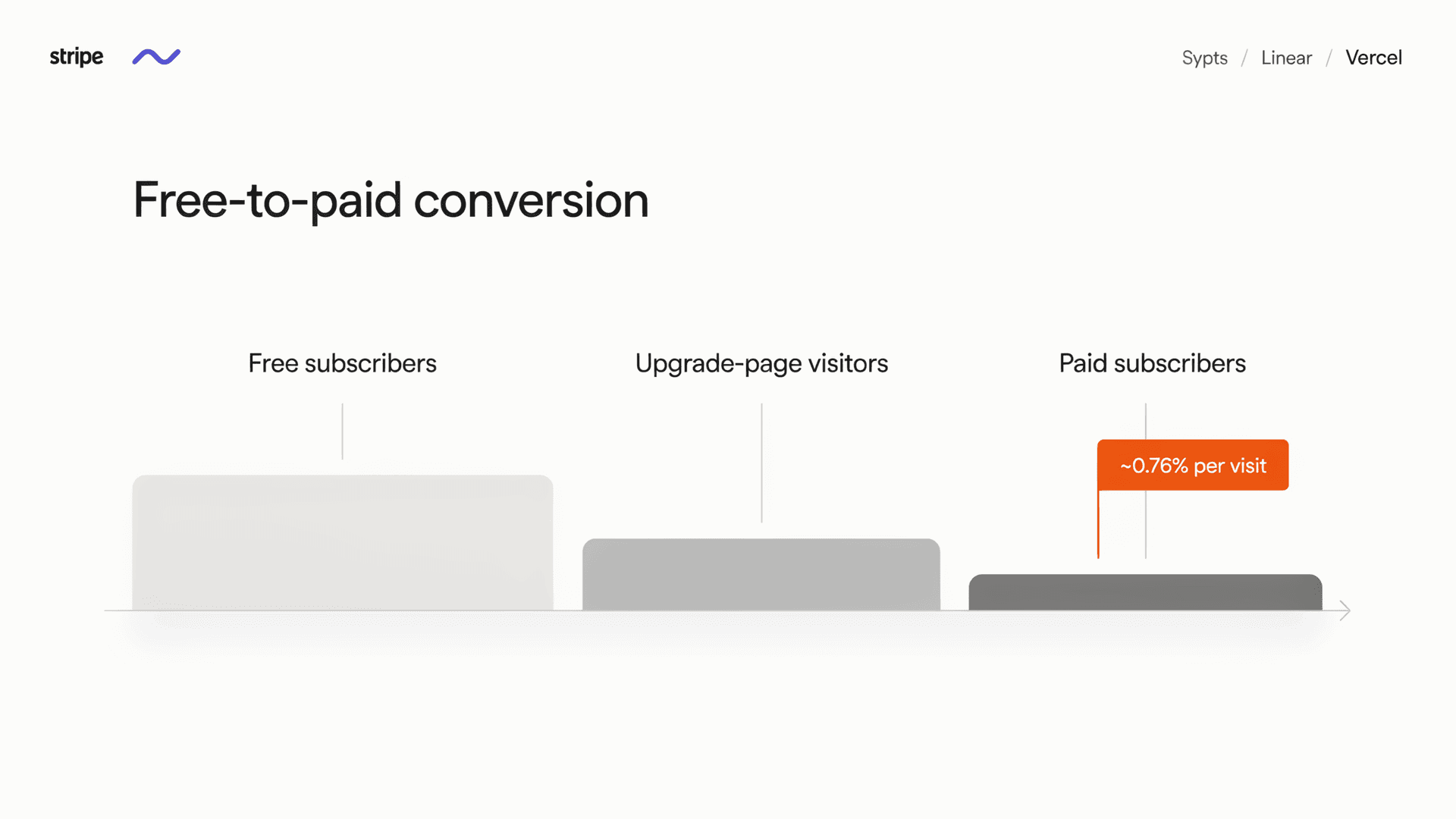
The short answer: A typical free-to-paid newsletter conversion rate is under 5% of free subscribers, and often under 1% measured per visit, one study of freemium paywalls found an average of 0.76% (7.6 subscriptions per 1,000 visits). Warm readers who actually reach an upgrade page convert much higher. The fastest way to lift the number is to optimize each step of the funnel and test the upgrade page in revenue.
Every newsletter creator wants the same number to go up: the share of free readers who become paying subscribers. But almost nobody knows what "good" looks like, so they either panic at a 2% rate that's actually normal, or chase a 10% rate that almost no one hits.
This piece gives you the real benchmarks, shows you how to calculate your own rate the right way, and lays out the levers that actually move it. The encouraging part: because conversion is a chain of steps, small improvements compound into big revenue.
What is a good free-to-paid newsletter conversion rate?
For most newsletters, a healthy free-to-paid conversion rate sits under 5% of free subscribers, and often below 1% when measured per visit to a paywalled page. A study of 99 publishers by The Audiencers found freemium paywalls converted an average of 7.6 subscriptions per 1,000 monthly visits, about 0.76%. Metered paywalls converted fewer. So if you're converting 2-4% of engaged free subscribers to paid, you're doing well, not poorly.
The number that trips people up is the denominator. "Conversion rate" means very different things depending on what you measure against:
| Denominator | What it measures | Typical range |
|---|---|---|
| Per visit to a paywall | Of everyone who hits the wall | ~0.76% (freemium avg) |
| Per free subscriber | Of your whole free list, over time | Often 1-5% |
| Per upgrade-page visitor | Of warm readers who clicked "upgrade" | Single to low double digits |
High-value B2B, finance, and professional newsletters can run well into the double digits among warm visitors, because the audience is small, targeted, and price-insensitive relative to the value. Broad consumer newsletters competing with free alternatives sit lower. Treat any single benchmark as directional, not a target.
How to calculate your free-to-paid conversion rate
Pick one denominator and stay consistent. The two that matter most:
- List-level rate = paid subscribers ÷ total free subscribers. Good for tracking the business over time.
- Upgrade-page rate = paid conversions ÷ upgrade-page visitors. Good for optimization, because it isolates the page you can actually change.
The list-level rate tells you how the business is doing. The upgrade-page rate tells you whether your page is doing its job, and it's the one to focus on when you're testing, because everything upstream (subject lines, content, the click to upgrade) is filtered out.
Why free-to-paid conversion is low (and why that's normal)
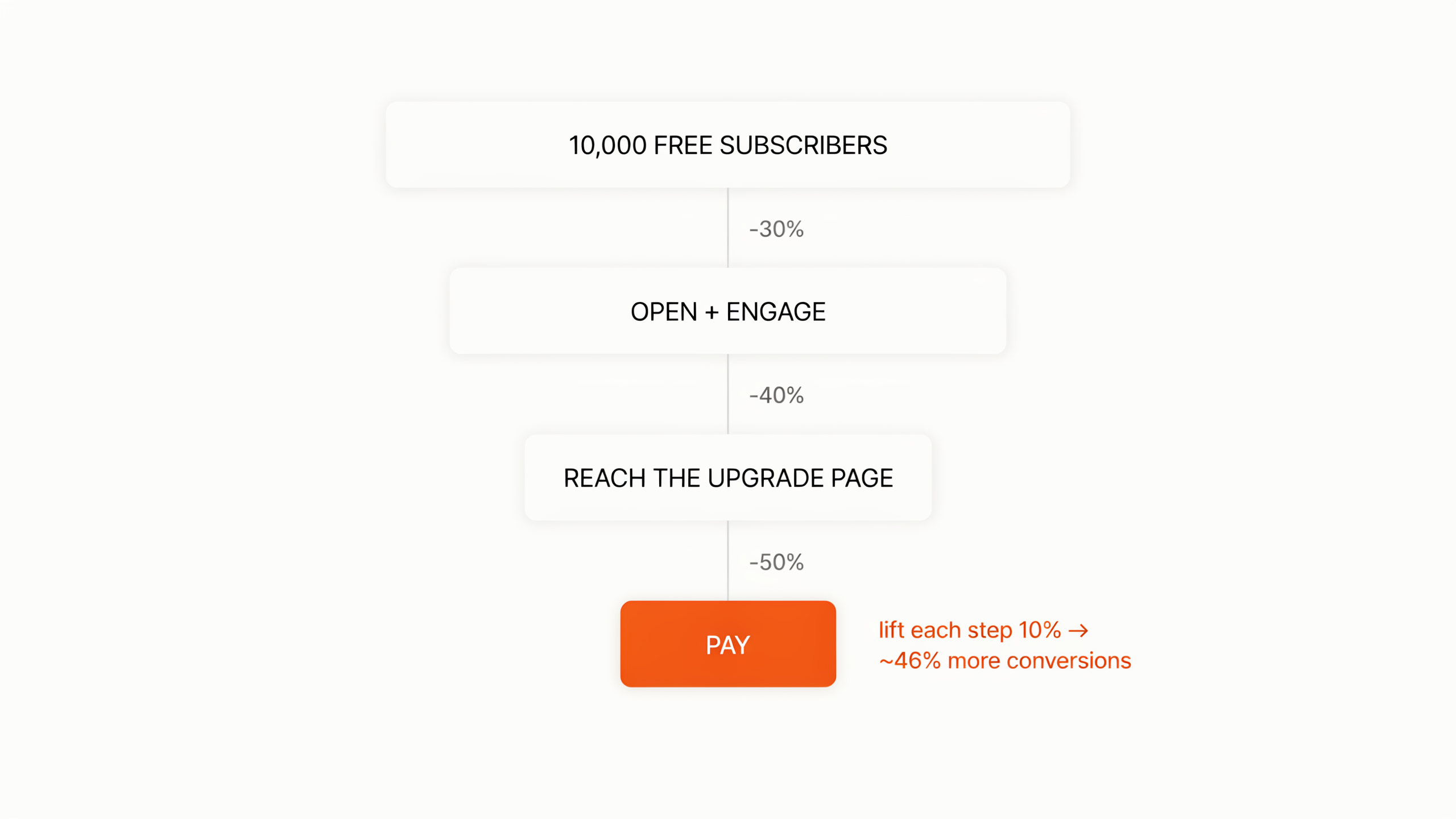
Conversion is low because paying is a high-friction decision sitting at the end of a multi-step chain. A reader has to open the email, engage with the content, click through to the upgrade page, find the offer compelling, and complete checkout. Each step sheds people. A sub-1%-per-visit rate isn't a failure, it's the math of a funnel with several leaks.
That framing is also the opportunity. Because the steps multiply, you don't need one heroic fix. The Audiencers' funnel analysis shows that improving each step by about 10% can raise overall subscription conversion by roughly 46%. Small, compounding wins beat one big swing.
How to improve your free-to-paid conversion rate
The levers, roughly in order of impact:
- Sharpen the upgrade page. This is the highest-leverage surface, headline, offer, pricing, social proof, and layout all live here. Lead with the outcome, not "Upgrade to Premium."
- Fix the offer and price framing. A free trial or a clear founder discount lowers the risk of a first payment. Annual-vs-monthly framing changes both conversion and revenue per subscriber.
- Place the paywall where intent peaks. Cut readers off after they're hooked, not before they've tasted value and not after they've gotten everything. (See the Beehiiv paywall guide.)
- Raise upstream quality. Better subject lines and content mean more engaged readers reaching the page in the first place.
- Tighten checkout. Every extra field or redirect leaks conversions at the most expensive moment.
Here's the catch: you can't improve what you can't measure, and you can't pick between two versions of a page by guessing. That's where most newsletters stall.
Why testing beats guessing (and how to do it on a newsletter)
The only way to know whether a lower price, a different headline, or a free trial lifts your rate is to test it head to head and measure the result in revenue. Beehiiv's built-in A/B testing only covers email subject lines, it can't split-test your upgrade page or paywall (more in our Beehiiv A/B testing guide).
Humblytics fills that gap. It runs server-side split tests on the upgrade page and scores the winner in subscription revenue (MRR) rather than clicks, so a variant that converts slightly fewer people at a higher price can still win if it makes more money. It's cookie-free (no consent banner), about 16KB, and starts at $79/month with A/B testing included on every plan. The step-by-step is in How to A/B test newsletter upgrade pages. Use the Sample Size Calculator to plan how long a test needs to run on your traffic.
Frequently asked questions
What is a good free-to-paid conversion rate for a newsletter? Under 5% of free subscribers is typical, and under 1% per visit to a paywall is common (freemium paywalls average about 0.76%). Among warm readers who reach an upgrade page, rates can run into the low double digits, especially in high-value niches.
Why is my newsletter's free-to-paid rate so low? Because converting a reader to paid is a multi-step decision with friction at each step. A low per-visit rate is normal; the win comes from improving several steps a little, which compounds.
How do I calculate free-to-paid conversion rate? Divide paid subscribers by your chosen denominator, total free subscribers (list-level) or upgrade-page visitors (page-level). Use the page-level rate when you're optimizing, because it isolates the surface you can change.
Can I A/B test my newsletter's conversion rate? Not inside Beehiiv, which only tests subject lines. Use a page-level tool like Humblytics to split-test the upgrade page and read the winner in revenue.
Is a 10% free-to-paid rate realistic? Rarely at the list level. Double-digit rates usually show up only among warm upgrade-page visitors in niche, high-value newsletters. Aiming to move your own baseline up beats chasing someone else's headline number.
Sources
- The Audiencers, What explains subscription conversion success (0.76% freemium paywall benchmark; 99-publisher study)
- The Audiencers, Increase subscription conversion by 46% (compounding funnel math)
- Email A/B Testing Tool for Newsletters, beehiiv (native testing is subject-line only)